AI Receptionist vs. Answering Service: An Honest Comparison

Sooner or later every small business owner asks the same question: "Who is going to answer the phone when I can't?"
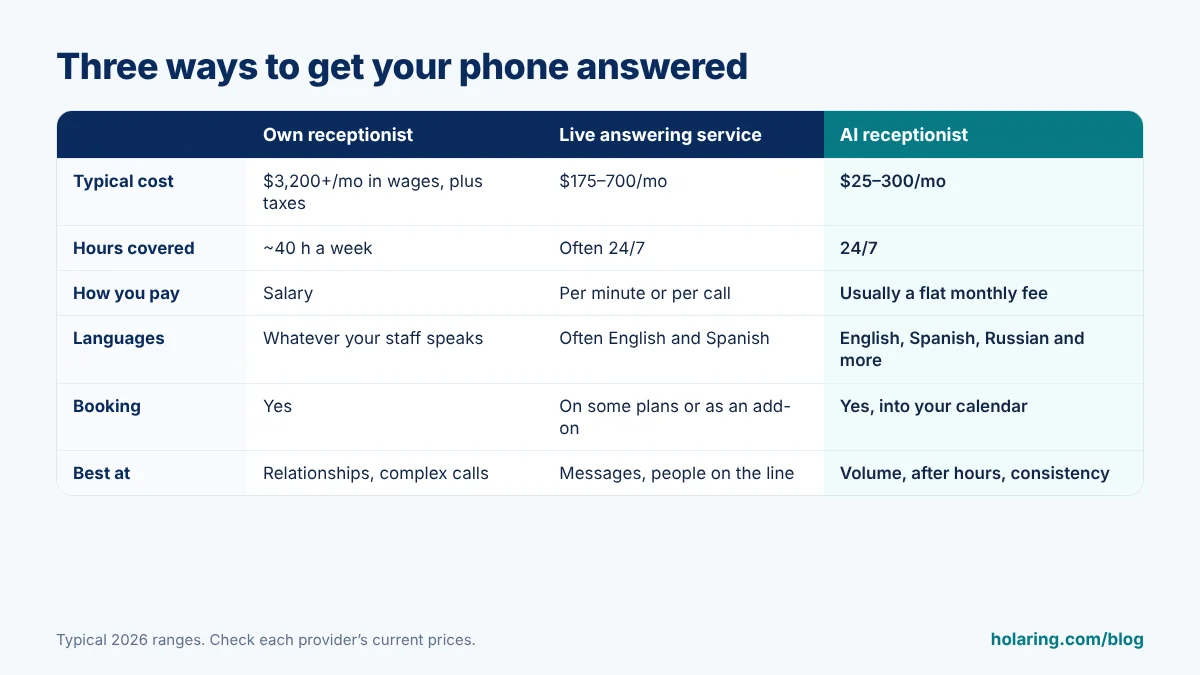
There are really three answers. You hire a person. You pay an answering service to pick up for you. Or you set up an AI receptionist. Each one works for some businesses and is a bad fit for others. I'll walk through all three with real 2026 prices and the billing details that sales pages tend to skip.
A disclosure before we start: I run HolaRing, which sets up AI receptionists. So read this knowing where I stand. I'll try to be fair, including about where humans are still the better choice.
Option 1: Your own receptionist
A person at your front desk is still the gold standard for some businesses. They know your regulars by name, they can calm an upset customer, and they can handle the odd request nobody planned for.
The cost is the problem. According to the U.S. Bureau of Labor Statistics, receptionists earned a median of $18.27 an hour, or $38,010 a year, in May 2025. That's before payroll taxes, paid time off and any benefits. And a full-time employee covers about 40 hours a week. Your phone can ring during all 168.
So even businesses with a great front desk still miss calls: at lunch, after closing, on weekends, and whenever two people call at once.
Option 2: A live answering service or virtual receptionist
Here a team of remote receptionists answers your calls under your business name. Many of these services are good. Some will take messages only; others will also book appointments, answer common questions and transfer calls to you.
What owners often don't realize is how they bill. Most charge per minute against a monthly bundle, and the details matter:
- Rounding. Some services round every call up to the next full minute, so a 10-second wrong number is billed as a minute.
- Extra time. Hold time and the minutes a receptionist spends writing up the message after the caller hangs up may count too.
- Overage. Go over your bundle and the extra minutes are often several dollars each.
To make that concrete: as of early November 2026, Ruby, one of the best-known services, listed plans from $250 a month for 50 minutes up to $1,725 for 500 minutes, with overage around $4 to $5.40 per minute, according to a pricing breakdown that reviewed its pricing page and help center. Smith.ai bills per call instead: its live receptionist plans were listed at $300 a month for 30 calls and $810 for 90 calls, with paid add-ons for things like appointment booking.
Across the industry, an OnceHub review from September 2026 put typical small-business answering service costs at about $175 to $700 a month, rising well above that at higher volume.
Prices change, so always check the provider's current pricing page. But the pattern holds: live answering is a real service with real people, and you pay for every minute of their time.
Option 3: An AI receptionist
An AI receptionist is a voice assistant set up with your business information. It answers instantly, talks with the caller in natural language, answers common questions, takes their details, books appointments into your calendar and emails or texts you a summary.
Pricing usually works differently. Most AI receptionists charge a flat monthly fee with a generous minute or call limit. The same OnceHub review put the range at about $25 to $300 a month, with most full-featured options between $50 and $200. Some providers also charge a setup fee if they build and test the script for you.
The catch is quality, and it varies a lot. A cheap AI that reads a generic script, mishears names and can't book anything will annoy your customers. A well-configured one, built with your real prices, hours and rules, can handle most routine calls very well. The difference is almost entirely in the setup.
A real-world cost example
Let's say your business gets about 100 calls a month that you can't answer, averaging 3 minutes each. That's roughly 300 minutes.
- Live answering, per minute: 300 minutes doesn't fit a 200-minute plan, so you'd either pay overage or move to a larger bundle. At the published prices above, that's roughly $1,100 to $1,200 a month.
- Live answering, per call: 100 calls on a 90-call plan comes to about $900 a month with overage for the extra 10 calls, before add-ons like booking.
- AI receptionist: typically $50 to $300 a month for that volume, sometimes plus a one-time setup fee. Our own Starter plan, for example, is $399 to start (setup plus the first month), then $149 a month for up to 300 minutes.
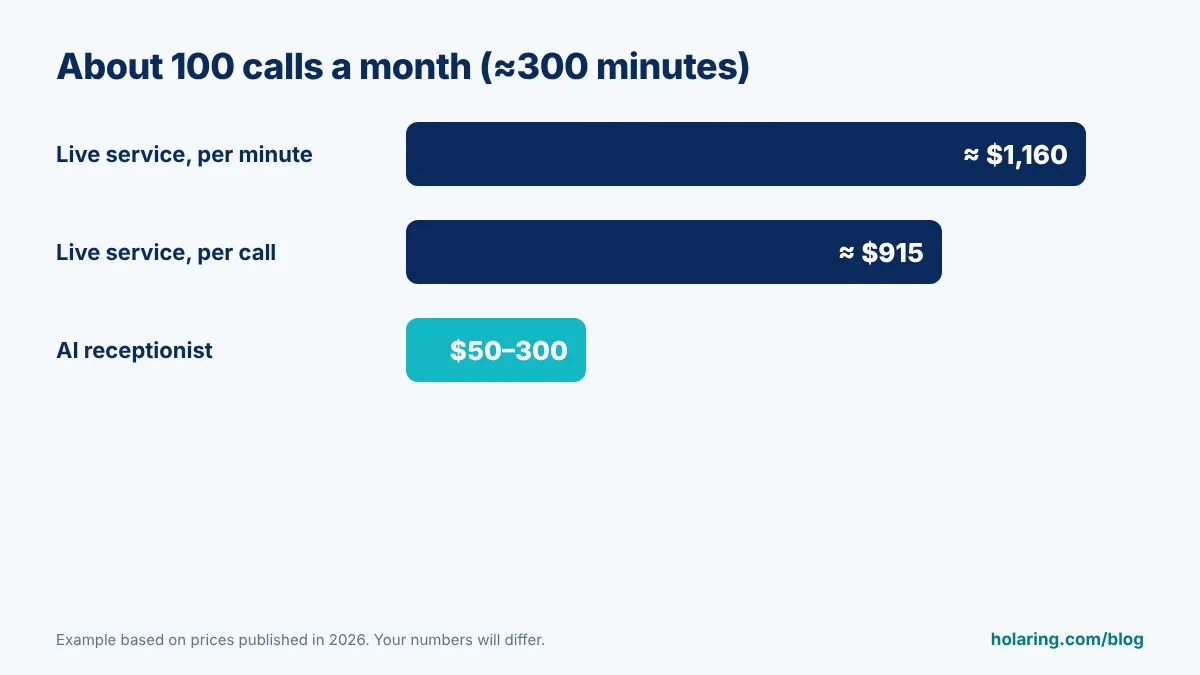
That gap is why so many small businesses are trying AI. But price is not the only thing that matters.
Where people still do it better
I'd be lying if I said AI is better at everything. Humans are still the better choice when:
- The call is emotional. Someone upset, grieving or frightened needs a person.
- Every call is different and complex. If almost no two calls are alike and each needs judgment, AI will spend a lot of time saying "let me have someone call you back."
- The caller is a VIP. Some clients expect to hear a familiar voice, and that relationship is worth paying for.
- Sensitive information is involved. Medical offices handling patient health information need a provider that will sign the right agreements (in the U.S., a HIPAA business associate agreement). Don't skip that step, with humans or with AI.
Where AI does it better
On the other hand, AI receptionists are hard to beat when:
- Calls pile up. Five people calling at once is no problem. Nobody waits on hold.
- It's after hours. At 11 PM on a Sunday the AI sounds exactly like it does at 10 AM on a Tuesday.
- Your callers speak different languages. A good AI receptionist can answer in English, Spanish and Russian and switch when the caller does. In our own test calls, we saw people mix Russian and English in the same sentence, which is completely normal in Miami, and the system had to be tuned to handle that instead of jumping between languages.
- You want the same answer every time. It never forgets your prices, never has a bad day, and you get a written summary of every call.
Questions to ask any provider
Whatever you choose, ask these before you sign:
- How exactly do you bill: per minute, per call, or flat? Do you round calls up?
- What happens when I go over my plan?
- Can you book directly into my calendar? Which calendars?
- What languages can you answer in, and who decides which one to use?
- How do urgent calls reach me? Can you transfer a call live to my cell?
- Will I get a summary or recording of every call?
- Is there a long contract, and how do I cancel?
- Can I hear a demo of how you'd answer for a business like mine?
The hybrid option most businesses end up with
In practice, many owners don't pick just one. They answer the phone themselves or with their staff during the day, and forward calls to an assistant only when nobody picks up within a few rings, or after hours. That way regular customers still hear a familiar voice most of the time, and nobody falls through the cracks.
If you're curious how an AI receptionist would sound for your type of business, leave your details here to get our demo number and call it yourself. Boris will follow up within one business day to answer questions. No obligation.
Sources
- U.S. Bureau of Labor Statistics, Occupational Outlook Handbook: Receptionists
- NextPhone, "Ruby Receptionist Pricing (2026)" (a competitor's review of Ruby's public pricing; check Ruby's site for current prices)
- NextPhone, "Smith.ai Pricing (2026)" (a competitor's review; check Smith.ai's site for current prices)
- OnceHub, "Answering Service Cost in 2026"
Hear an AI receptionist answer calls for a business like yours
Leave your details in a 30-second form and you'll get a number to call it yourself.
Try it